
- Build-to-print work: the plant cuts to your design and reports against your drawing.
- 6,800 m² across two buildings in Hengli Town, Dongguan — production, inspection, and engineering under one roof.
- Whether the supply relationship survives a change in volume or specification. A supplier with one machine in the relevant family has a single point of failure.
- Build-to-print: we machine to your drawing and report back to it.
What does "supplier" actually commit a supplier to?
The question to ask a supplier is not what it can make today but what happens when the order doubles, or when the drawing changes at revision C. Capacity questions are really questions about queue structure: how many machines sit in the family that makes your part, and how much of their time is already committed.
A supplier with one machine in the relevant family has a single point of failure. Depth in the same family is what lets a part move to another lane rather than sit in a queue when a machine is pulled for service.
Ask what share of the machine hours in your part's family is already committed. It is an unusual question and a revealing one: a supplier that cannot answer it does not know its own queue, which means the date it gave you was an estimate rather than a schedule.
What is the certification position?
ISO 9001:2015, IATF 16949:2016 (excluding clause 8.3 product design), and ISO 14001:2015 — each with a certificate number verifiable with the registrar.
Tolerance, and the instrument behind it
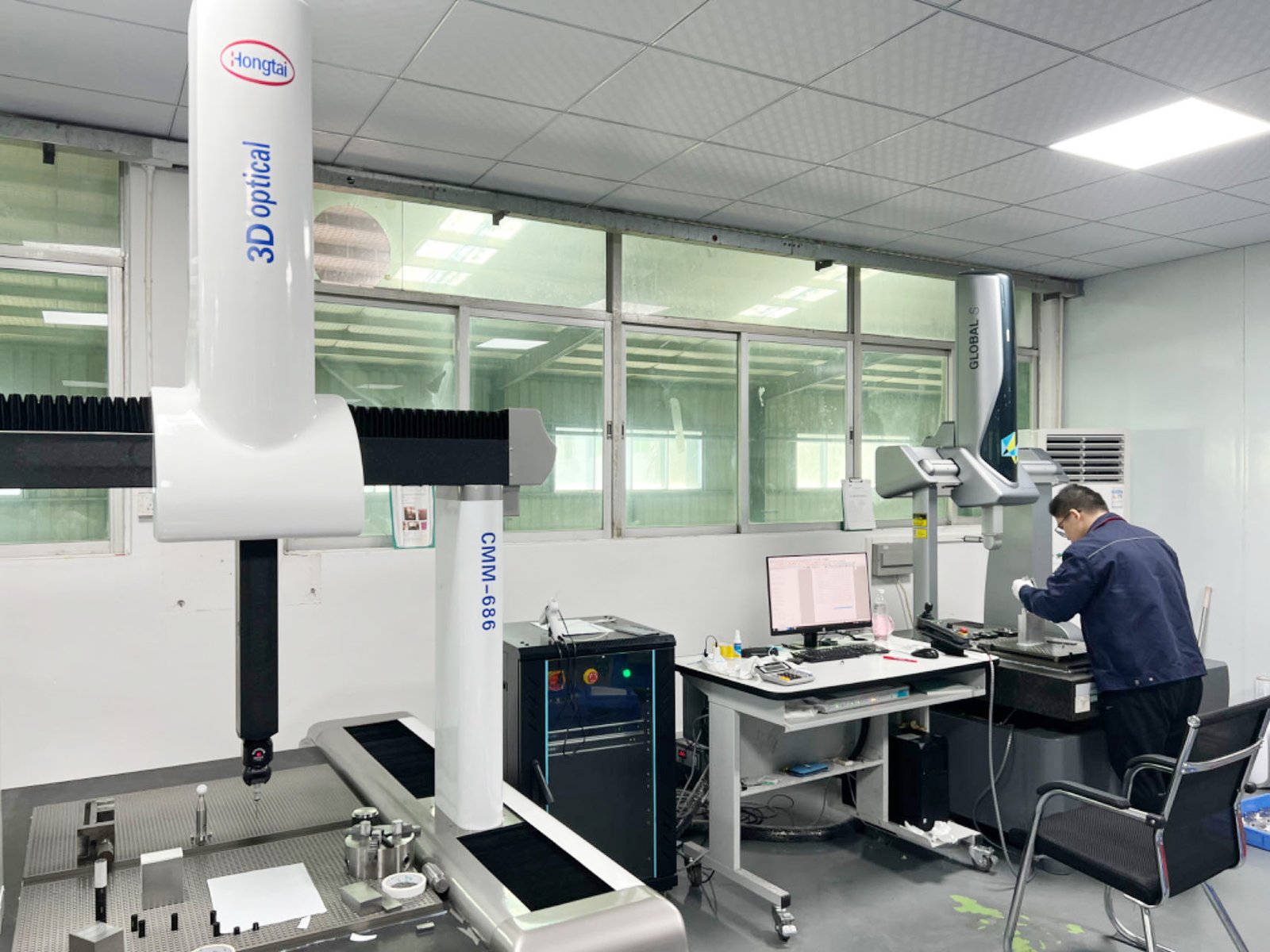
Milling and turning hold ±0.002 mm (turning) / ±0.003 mm (milling); precision grinding and wire EDM hold ±0.002 mm. A tolerance is only worth as much as the instrument that verifies it, so the floor runs 20+ inspection instruments alongside the machines — CMM for dimensional and true position, vision and profile instruments for surface and geometry, hardness testers and coating gauges for heat treatment and plating, and XRF for incoming material composition against the mill certificate.
The rule that matters on a drawing is that a tolerance is held by the process, not by the machine. Where a feature is tight, the finishing pass is separated from roughing, the part is allowed to stabilise, and the measurement is taken at a controlled temperature. a part measured warm is not the part the customer receives.
Which entity is responsible for the work?
Dongguan Zhuohang Ltd, registration 91441900MA4UWT6X39, established 2005.
What capacity actually sits behind the claim?
Capacity is depth, not a headline machine. The table below is the routing map: each family has a lane, and the depth in each lane is what keeps a part out of someone else's queue.
| Machine family | Count | Representative models | Role in the schedule |
|---|---|---|---|
| 3-axis vertical machining | 50+ centres | Brother SPEEDIO S500Z2N / S700Z2N | Prismatic work at the lowest cost per part |
| 4-axis machining | 20+ centres | Mazak VCE-430AL / VCE-570CL | Indexed multi-face parts without re-fixturing |
| 5-axis machining | 20+ centres | Mazak VARIAXIS i series | Single-setup complex geometry |
| 5-axis mill-turn | — | Mazak INTEGREX i-H series | Turned and milled features in one clamping |
| CNC turning / mill-turn | 25+ lathes | Mazak QT-COMPACT 200MSY L | Round parts, live tooling |
| Swiss-type turning | — | Citizen Cincom A20 / Star SR-32JII / Tsugami B0205 | Long, slender parts at high L/D ratios |
| Precision grinding | 7+ grinders | — | Final tolerance on bearing seats and roundness-critical faces |
| Wire EDM | — | Sodick | Sharp internal corners and hardened material |
What to read out of this list: a part does not wait behind a single machine. The spare capacity in that family is what lets work shift lanes instead of waiting in a queue, and it is what makes a prototype ramp to production on the same floor.
Three things that change the price without changing the part
For a repeat part, the lever is stability rather than price: hold the revision, hold the material source, and hold the process. A supplier can usually improve a repeat part's cost once the process is settled, but only if the drawing has not moved.
This is worth raising at quote stage rather than after the first article, because the changes are usually trivial on the drawing and significant on the machine.
How to verify a swiss machining supplier in an afternoon
Whether you buy from this plant or another, these checks separate a real floor from a brochure. None of them require a purchase order.
- Machine count in the specific family your part needs? Ask for it in writing.
- Second-source arrangement for outside processes? Ask for it in writing.
- How engineering changes are handled mid-production? Ask for it in writing.
- What happens to your slot when a larger customer expands? Ask for it in writing.
What happens between quote and first article?
Programming and offline verification, fixture design and build, material inward inspection, roughing, finishing, inspection, and the first-article report. Every step can go wrong in its own way, and the fixes that hurt most are the first and last steps. The manufacturability review is where cost is actually decided. A pocket depth reduced by a few millimetres, or an internal corner radius opened from 1 mm to 3 mm, cuts cycle time more than any change of machine. Because it changes the tool that can be used.
How to verify the shop, not just the quote
Beyond the price, you should check three things. The entity - who you are actually contracting with, because the legal entity and the marketing name are not always the same. The certificates - whether the ISO 9001:2015, IATF 16949:2016 and ISO 14001:2015 numbers are published and verifiable, not asserted. And the floor - whether the machines and the inspection actually exist, because a shop that cannot show a Hexagon CMM report cannot honestly claim a tight tolerance. This floor is Dongguan Zhuohang Ltd, 6,800 m² in Hengli Town, Dongguan, with 100+ CNC machines and the certificate numbers published.
The questions that separate a real shop from a broker
Ask three questions and listen to the answers. What machines run this part, and how many? A real shop names models - Mazak VARIAXIS I-600, INTEGREX I-250H S, Brother SPEEDIO, TSUGAMI and CITIZEN Swiss lathes. How do you verify a tight tolerance? A real shop points at the Hexagon CMM and the 10:1 gauge rule. Who is responsible if a batch is wrong? A real shop names the entity and stands behind it. Contact Felipe Iglesias at [email protected] or +86 13126536955 and ask those three questions before you place the order.
What the floor can actually prove
Behind the numbers is a floor you can walk. Dongguan Zhuohang Ltd runs 100+ CNC machines - the Mazak VARIAXIS I-600 five-axis, the INTEGREX I-250H S mill-turn, Brother SPEEDIO, and TSUGAMI, STAR and CITIZEN Swiss lathes - across 6,800 m² in Hengli Town, Dongguan. Every critical feature is checked on a Hexagon CMM under the 10:1 gauge rule, and the certificate numbers for ISO 9001:2015, IATF 16949:2016 and ISO 14001:2015 are published and verifiable. Capability is tracked with Ppk 1.67 or better at the initial study and Cpk 1.33 or better in production, which is the difference between a tolerance that is quoted and a tolerance that is held.
The same floor serves buyers worldwide - Austria, Belgium, the Czech Republic, Denmark, France, Germany, Greece, Hungary, Ireland, Italy, the Netherlands, Spain, Sweden and the United Kingdom in Europe; Brazil, Canada, Mexico and the United States in the Americas; China, Israel, Japan, Singapore and Sri Lanka in Asia; Australia and New Zealand in Oceania; and South Africa in Africa - with shipping from Dongguan. MOQ is 1 piece and lead times run roughly 3 / 7 / 30 days depending on material and documentation. Send the drawing and the quantity to Felipe Iglesias at [email protected] or +86 13126536955, and the quote comes back with the process behind it.
Your next step
A drawing and a quantity are all it takes to turn this page into a real part. Send a STEP or IGES model plus a 2D drawing carrying the tolerances, datums, material grade and finish, and name the quantity and the lead time. That returns an itemised quote - material, setup, cycle time, inspection - instead of a round number. If the drawing is not done, send what exists and the questions holding you back; starting the conversation matters more than waiting for a perfect package.
Reach Felipe Iglesias at [email protected] or +86 13126536955. MOQ is 1 piece, lead times run roughly 3 / 7 / 30 days, and the service area covers Austria, Belgium, the Czech Republic, Denmark, France, Germany, Greece, Hungary, Ireland, Italy, the Netherlands, Spain, Sweden and the United Kingdom in Europe; Brazil, Canada, Mexico and the United States in the Americas; China, Israel, Japan, Singapore and Sri Lanka in Asia; Australia and New Zealand in Oceania; and South Africa in Africa, with worldwide shipping from Dongguan.
What this shop actually runs
Ask for capability evidence and the answer should be specific. The facility behind this guide runs 100+ CNC machines on a 6,800 m2 floor in Dongguan, China, with 100+ staff. The machine list, by category:
- 5-axis machining centres (10+) - Mazak VARIAXIS I-600 (510/910/510 mm travel, 12,000 rpm, 22 kW, 71.6 N·m, 30-tool BT40) and Mazak INTEGREX I-250H S (B-axis 0.0001°, 24 kW, 124 N·m, 38-tool HSK-A63). Set up for compound-angle parts, single-setup multi-face prismatic work, and aerospace fittings where datum transfer loss is unacceptable.
- 3-axis / 4-axis machining centres (50+) - Brother SPEEDIO S500Z2N / S700Z2N (10,000 rpm, 14/21-tool ATC, 0.7 s tool-to-tool, Z-axis 2.2 G) and Mazak VCE-430A L / VCE-570C L (10,000 rpm, 118 N·m, 24-tool ATC). Set up for prismatic parts, plates, brackets, housings.
- Swiss-type turning centres (10+) - Citizen Cincom A20-3F7 (Φ20 mm, 10,000 rpm), TSUGAMI B0206-III / B0205-III (Φ20 mm, 0.1 µm), STAR SR-32JII / SR-32J Type N (Φ32 mm, 8,000 rpm). Set up for long, slender rotational parts at ±0.002 mm.
- CNC turning centres (20+) - HEADMAN T70M/1250 (720 mm swing, 117 mm bore, 3,000 rpm, BMT75 12-station turret). Set up for shafts, bushings, flanges up to ±0.002 mm.
- Wire EDM (5+) - Sodick AQ535L (550/350/300 mm travel, ±20° taper, 800 kg workpiece). Set up for hardened tool steel, internal splines, sharp internal corners that milling cannot reach.
- Inspection: Hexagon CMM + 20+ gauges - Hexagon CMM for coordinate measurement, plus vision system, profilometer, hardness tester, coating thickness gauge, XRF for material verification. The 10:1 rule (gauge 10x more accurate than the band) is applied to every feature.
- Machine highlights - VARIAXIS I-600: one-setup multi-face 5-axis + MAZA-CHECK auto-calibration; INTEGREX I-250H S: DONE-IN-ONE mill-turn, B-axis 0.0001° + Ai thermal shield; SPEEDIO S500Z2N / S700Z2N: Z-axis 2.2 G + 0.7 s ATC; Swiss-type: guide-bush switchable + 0.1 µm resolution.
Tolerances held: milling ±0.003 mm, turning ±0.002 mm, grinding and wire EDM ±0.002 mm. Capability: Ppk >= 1.67 initial and Cpk >= 1.33 in production on key characteristics.
Certifications: ISO 9001:2015 (116024/A/0001/UK/En), IATF 16949:2016 (131941/A/0001/SM/En, clause 8.3 design excluded, disclosed openly) and ISO 14001:2015 (116024/B/0001/UK/En), issued to Dongguan Zhuohang Ltd, USCC 91441900MA4UWT6X39, established 2005.
Service area: Austria, Belgium, the Czech Republic, Denmark, France, Germany, Greece, Hungary, Ireland, Italy, the Netherlands, Spain, Sweden and the United Kingdom in Europe; Brazil, Canada, Mexico and the United States in the Americas; China, Israel, Japan, Singapore and Sri Lanka in Asia; Australia and New Zealand in Oceania; and South Africa in Africa — built in China, shipped worldwide.
Contact: Felipe Iglesias, [email protected], +86 13126536955.
Send a drawing and get a manufacturability read
Upload your model for a quote, or arrange a factory audit with [email protected] or +86 13126536955. Ask for Felipe Iglesias.
Frequently Asked Questions
How is an engineering change handled mid-production?
The change is documented against a revision, the affected parts in process are identified, and the revised drawing is confirmed in writing before work restarts. The important part is that the revision in force at any moment is a single, written one.
How is material traceability maintained?
Incoming stock is checked against the mill certificate — composition by XRF, hardness where specified — and traceability is held per heat or per batch as the certificate defines it.
How quickly can you quote swiss machining?
Quotes are returned with a manufacturability read rather than a price alone — where a tolerance or a feature will drive cost, that is flagged at quote stage rather than after the first article. Turnaround depends on drawing completeness.
Do you hold stock or consignment for repeat orders?
Repeat orders can run against a forecast so stock and, where the part warrants it, dedicated fixturing are held ready. This is a commercial arrangement, not a standard term, so raise it at the second order rather than the first.
Is your IATF 16949 certificate valid for design work?
No. The certificate excludes clause 8.3 (product design). The plant is certified to manufacture to your design and to run the associated process controls, not to originate product design.
What files do you need for a quote?
In short, A 3D model (STEP or IGES) with a 2D drawing carrying the tolerances, surface finish callouts, material spec and any inspection or certification requirements. The drawing defines the contract — the model alone usually leaves the tolerance scheme unspecified.
Can you work to ASME Y14.5 as well as ISO?
Yes. Both geometric dimensioning conventions are used. The important thing is that the drawing states which one applies, because the same symbol can mean different things under the two standards.
Continue reading: 3 Axis Swiss Machining · 4 Axis Swiss Machining · 5 Axis Swiss Machining
Standards referenced on this page
- ASTM A582/A582M-12 — Standard Specification for Free-Machining Stainless Steel Bars
- ISO 9001 — Quality management systems — Requirements
- ASTM E8/E8M-21 — Standard Test Methods for Tension Testing of Metallic Materials